Agile software development is an iterative, collaborative approach to building software in small, working increments rather than in one massive release. Instead of spending months on planning and documentation before writing a single line of code, agile teams deliver usable features every few weeks, gather real feedback, and adjust course quickly. In a market where customer needs change fast, this flexibility has made the agile methodology the default way modern teams build products.
In this guide, you will learn what agile is, where it came from, its core values and principles, the most popular agile frameworks, the benefits and challenges, and how to adopt agile in your own team.
Origins of Agile and the Agile Manifesto
Before agile, most teams relied on the traditional waterfall model, where requirements, design, development, testing, and deployment happened in strict sequence. This worked for predictable projects, but it often failed in software, where requirements evolve and mistakes discovered late are expensive to fix.
In February 2001, seventeen software practitioners met in Utah and drafted the Agile Manifesto, a short document that reshaped the industry. It did not prescribe a process. It described a mindset: people, working software, collaboration, and adaptability matter more than rigid plans and paperwork.
The 4 Agile Values and 12 Principles
The Agile Manifesto is built on four core values:
- Individuals and interactions over processes and tools
- Working software over comprehensive documentation
- Customer collaboration over contract negotiation
- Responding to change over following a plan
These values are supported by twelve principles. The most influential ones include:
- Satisfy the customer through early and continuous delivery of valuable software.
- Welcome changing requirements, even late in development.
- Deliver working software frequently, from a couple of weeks to a couple of months.
- Business people and developers must work together daily.
- Build projects around motivated individuals and trust them to get the job done.
- Continuous attention to technical excellence and good design enhances agility.
- At regular intervals, the team reflects on how to become more effective.
How the Agile Development Process Works
- Build a Product Backlog: The product owner gathers ideas, features, and fixes into a prioritized list called the product backlog. Requirements are usually written as user stories.
- Plan the Iteration: During sprint planning, the team selects the highest-priority stories it can realistically complete in one iteration, usually one to four weeks.
- Develop and Test Continuously: Developers, testers, and designers work together with automated testing, code reviews, and continuous integration.
- Hold Daily Stand Ups: A brief daily meeting (15 minutes) helps the team share progress, surface blockers, and stay aligned.
- Review and Demonstrate: At the end of the iteration, the team demonstrates working software to stakeholders and collects feedback in a sprint review.
- Reflect and Improve: In the sprint retrospective, the team discusses what went well, what did not, and what to change next time. Then the cycle begins again.
Popular Agile Frameworks: Scrum, Kanban, XP and More
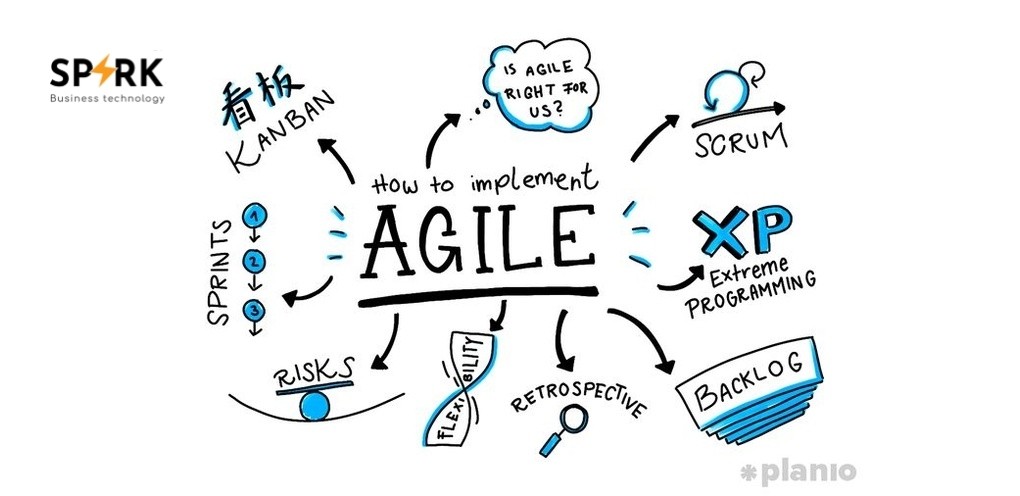
- Scrum: Fixed length sprints with defined roles (Product Owner, Scrum Master, Developers) and regular ceremonies. Best for product teams with evolving requirements.
- Kanban: Visualize work on a board, limit work in progress, and optimize flow. Best for support, maintenance, and continuous delivery teams.
- Extreme Programming (XP): Engineering practices like pair programming, test driven development, and frequent releases. Best for teams that prioritize code quality.
- Lean Software Development: Eliminate waste, deliver fast, and empower the team. Best for startups and cost conscious teams.
- SAFe (Scaled Agile Framework): Scales agile across many teams and large organizations. Best for enterprises with multiple coordinated teams.
Agile vs Waterfall: What Is the Difference?
- Approach: Agile is iterative and incremental; waterfall is linear and sequential.
- Requirements: In agile they evolve throughout the project; in waterfall they are fixed upfront.
- Delivery: Agile ships frequent, small releases; waterfall delivers one final release.
- Customer involvement: Agile involves customers continuously; waterfall mostly at the start and end.
- Risk: Agile detects risk early; waterfall often finds problems late.
- Flexibility: Agile is highly flexible; waterfall is rigid.
Key Benefits of Agile Software Development
- Faster time to market: Releasing in small increments gets value to users sooner.
- Higher product quality: Continuous testing and short feedback loops catch defects early.
- Greater flexibility: Teams can pivot when market conditions or customer priorities shift.
- Improved customer satisfaction: Stakeholders see progress regularly and shape the product.
- Better risk management: Problems surface within weeks, not months.
- Transparency and predictability: Boards, burndown charts, and demos make progress visible.
- Higher team morale: Self organizing teams enjoy more ownership and autonomy.
Common Challenges of Agile (and How to Overcome Them)
- Scope creep: Constant change can balloon a project. Keep a disciplined, prioritized backlog.
- Lack of documentation: Document what truly adds value rather than excessive paperwork.
- Cultural resistance: Agile requires trust and collaboration. Leadership buy in and coaching help.
- Difficult estimation: Use story points, track velocity, and refine estimates over time.
- "Fake agile": Focus on customer outcomes rather than just following ceremonies.
Agile and DevOps: A Natural Partnership
Agile focuses on how teams plan and build; DevOps focuses on how software is integrated, deployed, and operated. Together, they create a pipeline in which ideas move from backlog to production quickly and reliably, supported by continuous integration and continuous delivery (CI/CD), infrastructure automation, and monitoring.
Conclusion
Agile software development is far more than a set of meetings or a project management trend. It is a mindset built on collaboration, transparency, and continuous improvement. By delivering value in small steps, listening to feedback, and adapting quickly, agile teams build better software, reduce risk, and keep customers at the center of every decision.
Whether you choose Scrum, Kanban, or a hybrid, the key is to start small, stay consistent, and keep improving. Teams that master the agile methodology are better positioned to innovate and compete in a fast-moving digital world.